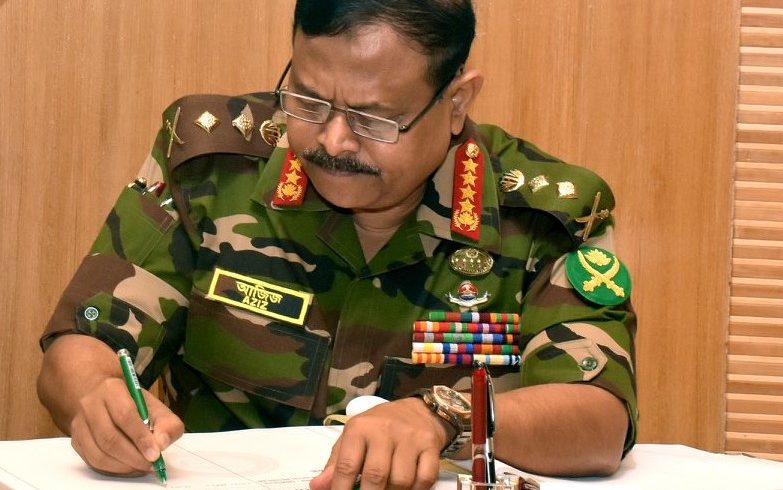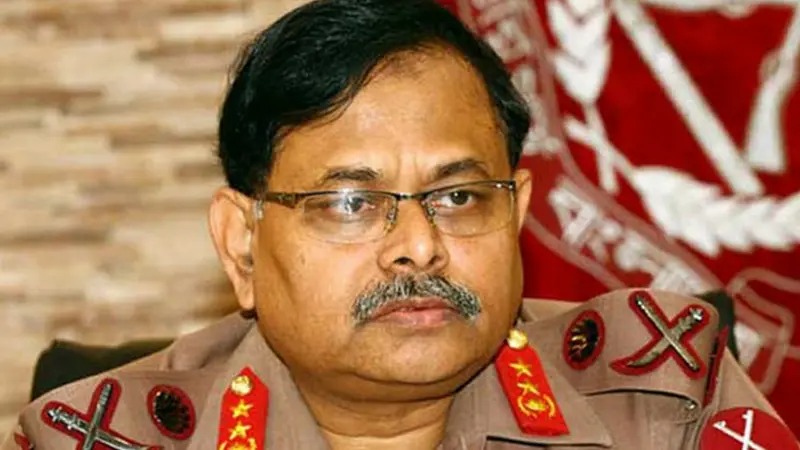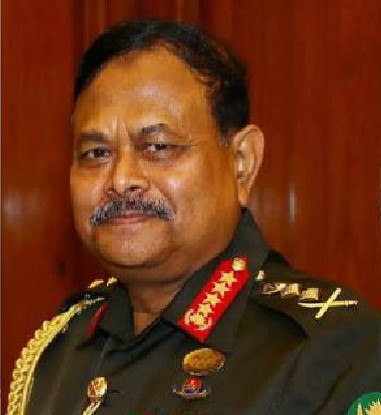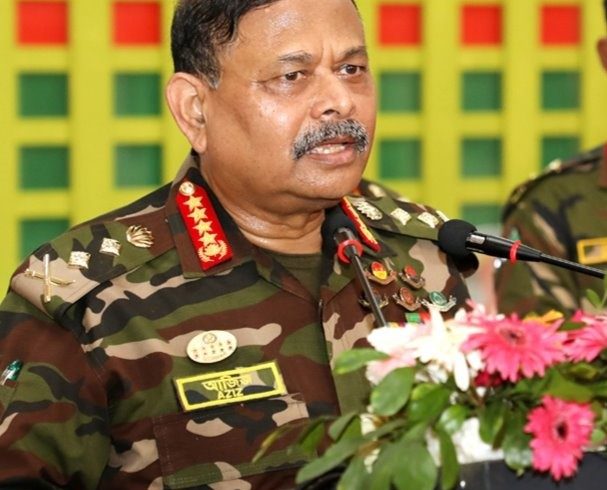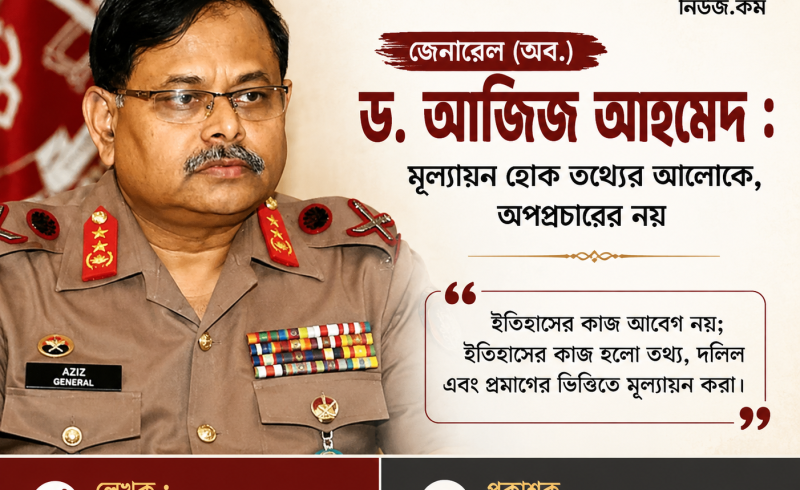
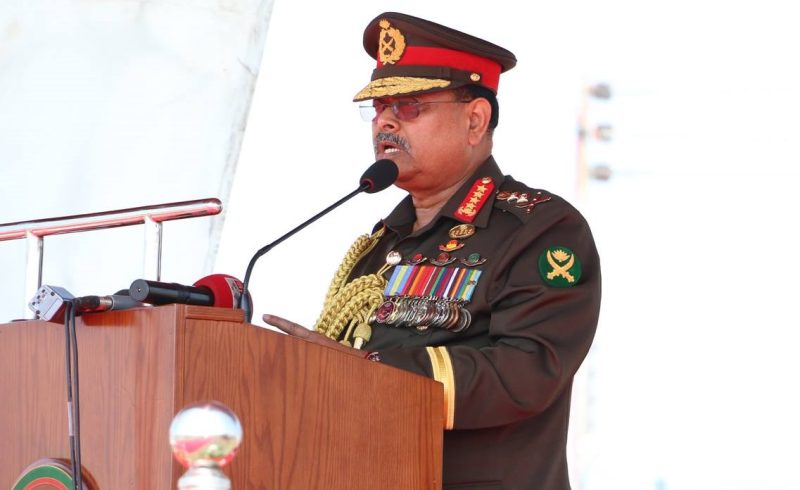
In the military history of Bangladesh, the tenure of every Chief of Army Staff is defined by certain distinctive characteristics, decisions, achievements and assessments. It is not possible to fully evaluate the role of a Chief of Army Staff within an institution merely by considering his rank or the period during which he held office. His style of leadership, professional preparation, organizational reforms, vision for modernization, training, welfare initiatives, role in matters of national security, and the questions that emerge regarding his career after leaving office—all these aspects need to be considered within the same context. In this sense, the career of General (Retd.) Dr. Aziz Ahmed represents an important and multifaceted chapter in the history of military leadership in Bangladesh.
General (Retd.) Dr. Aziz Ahmed was born on January 1, 1961, in Narayanganj, while his ancestral home is in the village of Dakshin Torki in Matlab Uttar Upazila of Chandpur District. He was commissioned into the Bangladesh Army’s Artillery Corps on June 10, 1983, from the 8th BMA Long Course of the Bangladesh Military Academy. During his long military career, he held various command, staff, training and senior-level appointments. According to the official list of the Bangladesh Army, he served as Chief of Army Staff from June 25, 2018, to June 24, 2021. One notable aspect of his professional career is that he did not gain experience solely within the conventional command structure. He also served in various areas involving border management, training and military doctrine, administrative management and modernization of the Bangladesh Army. His extended tenure in the leadership of the then Bangladesh Rifles, later known as the Border Guard Bangladesh, and his subsequent responsibility at the Army Training and Doctrine Command were important stages in his career. Before assuming the position of Chief of Army Staff in 2018, he also served as Quartermaster General.
Foundation of His Military Career
The leadership style of a military officer is shaped to a considerable extent by the experiences gained through previous assignments. This was also true in the case of General (Retd.) Dr. Aziz Ahmed. At various stages of his military career, he commanded artillery regiments, served at brigade level, worked in training institutions, performed intelligence- and operations-related duties, and held senior command appointments. He subsequently served as the General Officer Commanding of the 33 Infantry Division and also led the Bangladesh Rifles, the organization that later became known as the Border Guard Bangladesh, or BGB.
His tenure in the Border Guard Bangladesh between 2012 and 2016 was one of the most significant chapters of his professional career. Such diverse experience is important when assessing military leadership because a modern army is not merely an institution responsible for conducting warfare. It also involves training, personnel management, technology, logistics, border security, international peacekeeping, disaster response and coordination with the broader national security structure. A Chief of Army Staff must understand the interrelationship among all these areas.
General (Retd.) Dr. Aziz Ahmed also had a broad educational and professional background. Alongside his military education, he pursued higher studies in defense studies, technical subjects and business administration. According to biographical information published by the Bangladesh Army, he was a graduate of the Defense Services Command and Staff College and participated in various professional courses, seminars and symposia at home and abroad. He was also associated with professional research and publications. One point deserves particular emphasis here: in military leadership, the combination of professional knowledge and practical experience influences an officer’s capacity for decision-making. This combination can be observed throughout General Aziz’s career. In particular, his involvement in training and the development of military doctrine provided an important professional foundation for his subsequent leadership as Chief of Army Staff.
Leadership of the Border Guard Bangladesh
One of the most significant chapters in the career of General (Retd.) Dr. Aziz Ahmed was his leadership of the Border Guard Bangladesh—BGB. He served as the Director General of the BGB, the successor to the then Bangladesh Rifles, from December 2012 to November 2016. His tenure came at a time when border management, law and order, and the organizational capabilities of the force were important issues in national security discussions. Leading an organization such as the BGB requires a different set of skills from those normally associated with conventional army command. Alongside ensuring border security, a border-guarding force must deal with local communities, civil administration, law-enforcement agencies, diplomatic realities and relations with neighboring countries.
Therefore, experience at this level helps a military leader understand not only leadership in the conventional military sense, but also the broader realities of national security. It can be reasonably assessed that this experience in border management and organizational leadership had an influence on his subsequent approach to leadership. At the same time, any assessment of his tenure in this position should consider not only his professional role but also the political environment of the period. This is not a judgment against an individual; rather, it is a necessary approach to understanding the broader historical context.
Emphasis on Training and Military Doctrine
Another significant area of General (Retd.) Dr. Aziz Ahmed’s career was the Army Training and Doctrine Command, or ARTDOC. A professional document published by the Bangladesh Army states that he assumed command of ARTDOC on November 16, 2016, and undertook various initiatives in the areas of training and military doctrine. The document specifically refers to an initiative to develop a doctrine for conducting military operations in mountainous areas. The true capability of a modern military force is determined not merely by the number of weapons or personnel it possesses. As the nature of warfare changes, training and doctrine must also evolve. In an era of mountainous and border operations, urban warfare, cyberspace, drone technology, information warfare and multidimensional security threats, a military force must continuously prepare itself for new challenges.
Training, therefore, needs to be viewed as an ongoing process. A modern army cannot be built by leaving outdated training methods unchanged.
This is where the significance of General (Retd.) Dr. Aziz Ahmed’s work at ARTDOC can be understood. Bangladesh Army documents also refer to the publication of various training manuals and guidelines during his leadership. These initiatives should not be exaggerated as the personal achievements of one individual; rather, it is more reasonable to view them as part of a broader institutional process. No military doctrine is developed by a single individual alone. Trainers, researchers, planners, commanders and relevant institutions all contribute to the process. The role of leadership is to provide direction to that process and prepare the institution for necessary changes.
Assumption of Office as Chief of Army Staff
On June 25, 2018, General (Retd.) Dr. Aziz Ahmed assumed office as Chief of Army Staff of the Bangladesh Army. His appointment was announced on June 18, and he was appointed for a three-year term. Before assuming the position, he was serving as Quartermaster General.
His tenure as Chief of Army Staff coincided with an important period in Bangladesh’s political and social landscape. The 2018 national election, the subsequent political environment, the relationship among state institutions, border security and the modernization of the Bangladesh Army collectively made it a complex period. The foremost responsibility of a Chief of Army Staff is to maintain the professionalism, discipline and organizational capability of the force. Within the constitutional framework of the state, the position of the armed forces is clearly defined. Therefore, even amid political controversy, maintaining the professional neutrality of the military institution, its commitment to national security and its organizational unity remains an important test of leadership.
There have been various assessments of General (Retd.) Dr. Aziz Ahmed’s tenure. Publications of the Bangladesh Army have portrayed his period as one in which the pace of reform, welfare and modernization increased. However, such institutional assessments should be understood as representing the perspective of the institution itself. An independent assessment requires consideration of other sources, actual outcomes and subsequent developments as well.
The Question of Reform and Modernization
Modernization of an army is not a one-time project. It is not limited to acquiring new weapons, establishing new units or introducing new technologies. Genuine modernization includes improving command structures, modernizing training, adopting technology, strengthening medical and welfare services, improving housing, communications and logistics, upgrading information systems, and developing human resources.
Supporters of General (Retd.) Dr. Aziz Ahmed have identified rapid change and institutional reform as notable features of his leadership. Documents published by the Bangladesh Army have also emphasized increased momentum in welfare and reform during his tenure. However, the most important consideration in military reform is that change should not remain limited to visible infrastructure. Constructing a new building is relatively easy; developing an effective training system is much harder. Purchasing new technology is comparatively easy; developing skilled personnel capable of using that technology effectively is much more difficult. Drafting new policies may be straightforward; implementing them effectively at the field level is considerably more challenging. For this reason, evaluating General (Retd.) Dr. Aziz Ahmed’s tenure requires more than examining announcements of reform. It is also important to consider their actual results, sustainability and how those reforms were managed in subsequent years.
Soldier Welfare and Humanitarian Leadership
One of the major sources of strength within a military institution is the confidence of its personnel. When a soldier believes that his family is secure, medical and educational facilities are adequate, housing conditions are improving and his professional future is well structured, his confidence in the institution increases.
Publications of the Bangladesh Army have emphasized the importance given to soldier welfare and infrastructural development during the leadership of General (Retd.) Dr. Aziz Ahmed. Soldier welfare should not be viewed merely as a matter of facilities and benefits. The life of a service member is associated with strict discipline, risk and prolonged periods of separation from family. The security and welfare of his family also affect the morale of the military institution. Housing, healthcare, education, food, post-retirement security and family support are therefore all components of military capability.
This is where a humanitarian dimension of leadership emerges. A Chief of Army Staff does not prepare a force solely for war; he also influences the quality of life of the soldiers who constitute that force.
Professionalism and Leadership Style
Understanding the leadership of General (Retd.) Dr. Aziz Ahmed requires consideration of his extensive field experience. He served in artillery, commanded an infantry division, led a border-guarding force, headed a training command and held various responsibilities at Army Headquarters. As a result, his leadership reflected a combination of field-level realities and high-level administrative decision-making. One of the central questions in military leadership is how much change a leader can introduce while simultaneously preserving institutional continuity.
Excessive change can destabilize an institution, while a lack of change can cause an institution to fall behind the demands of time. Effective leadership requires a balance between these two extremes. His experience in training, border management and command provided him with a broad professional foundation for maintaining such a balance.
The State, the Army and Constitutional Responsibility
In a country like Bangladesh, the role of the armed forces is multidimensional. Although national defense remains their primary responsibility, the military also contributes to disaster response, infrastructural support, international peacekeeping and various national emergencies. Therefore, the responsibility of a Chief of Army Staff extends beyond the internal administration of the force. Within the constitutional framework, he must coordinate with the national leadership, civil administration and other security institutions.
This is perhaps the greatest ethical test of military leadership: maintaining a clear boundary between proximity to power and the professionalism of the institution.
What Can Be Learned from the Assessment of Change
The greatest lesson that can be drawn from General (Retd.) Dr. Aziz Ahmed’s career is the need to distinguish between institutional change and personality-centered leadership.
A leader may initiate change within an institution, but such change becomes sustainable only when it becomes part of rules, institutions, skilled human resources and mechanisms of accountability.
An institution cannot survive in the long term on the basis of an individual leader’s popularity or influence. Similarly, to properly evaluate reform, it is necessary to examine whether the institution became more effective after the changes, whether decision-making became more transparent, whether the quality of training improved, whether technology was used effectively and whether the welfare of its members genuinely improved. In this context, General (Retd.) Dr. Aziz Ahmed’s professional experience in training and military doctrine is particularly significant. A modern military force has no alternative to continuous learning and professional development.
Legacy: Neither One-Dimensional nor Absolute
It is difficult to characterize the legacy of General (Retd.) Dr. Aziz Ahmed simply as either positive or negative. His military career includes extensive professional preparation, several important command appointments, leadership of a border-guarding force, involvement in training and doctrinal development, and service as Chief of Army Staff from 2018 to 2021.
History does not judge an individual solely by his own statements. It judges through documents, decisions, institutional outcomes, contemporary reactions and subsequent developments. In the case of a Chief of Army Staff, an even more important question is how enduring the changes introduced during his tenure have been and what kind of institutional legacy his leadership has left behind.
Conclusion
The career of General (Retd.) Dr. Aziz Ahmed represents a complex and significant chapter in the history of military leadership in Bangladesh. From the beginning of his military career to his tenure as Chief of Army Staff, his professional journey was long and multifaceted. His commission into the Artillery Corps, various command and staff appointments, leadership of the border-guarding force, involvement in training and military doctrine, and ultimately his service as Chief of Army Staff together reflect a broad range of military experience.
During his tenure as Chief of Army Staff, institutional and official publications highlighted initiatives relating to reform, modernization and welfare. An important aspect of his leadership was the emphasis placed on training and professional capability. These are undoubtedly important elements of a modern military force. Yet leadership can never be evaluated solely through a list of achievements. To assess a leader’s legacy, it is equally necessary to consider the consequences of his decisions, their impact on institutions, public confidence and questions of accountability.
The chapter of General (Retd.) Dr. Aziz Ahmed is therefore not merely a biography of a Chief of Army Staff. It also provides an opportunity to understand the relationship among state institutions, military professionalism, reform, leadership, power, accountability and public trust in Bangladesh.
The greatest legacy of a leader is not the position he holds; it is the institution he leaves behind. The greatest strength of an institution does not lie in its dependence on any individual, but in its foundation of rules, professionalism, competence, accountability and public confidence. From this perspective, the career of General (Retd.) Dr. Aziz Ahmed allows us to see, on the one hand, the leadership, training and reform initiatives of a highly experienced military officer; on the other hand, it reveals the complex relationship among power, family, institutions and accountability. It is this dual reality that makes his legacy more than a one-dimensional narrative and turns it into an important chapter for historical consideration.
Ultimately, the success of a military leader does not depend solely on how quickly he brings about change. More important is whether he succeeds in leaving behind an institution capable of moving forward in his absence—with professionalism, discipline, ethics, modernization and public confidence. Perhaps this is the most important lesson of Dr. Aziz Ahmed’s career: leadership can initiate change, but institutions ensure its sustainability. And institutions are strengthened not merely by authority, but by knowledge, professionalism, ethics, transparency and accountability.
Author:
Azam Patwary
Publisher
RDM Media & Publication.